

ACT Geometry Made Easy: 9 Must-Know Topics, Formulas, and Strategies
If you’re studying for the ACT, you’re almost guaranteed to run into a good number of geometry questions.
For many students, this can feel overwhelming.
By the time most students take the ACT, it’s been a while since they studied shapes, angles, or circles. For some, geometry was never their strongest subject to begin with.
Fortunately, ACT geometry is much more straightforward than high school geometry. There are no proofs, no constructions, and no theorems to explain. Just formulas, figures, and solving for unknowns.
While ACT geometry makes up a larger portion of the test than it does on the SAT, the concepts are highly repetitive and conquerable with review. Once you review the key concepts, you’ll find that it’s surprisingly manageable.
In this guide, we’ll show you exactly what to focus on: the most tested concepts, the must-know formulas, and the strategies that will help you work through geometry questions with confidence.
Jump to section:
How Much Geometry Is on the ACT?
The 9 Most Important ACT Geometry Topics
- Lines and Angles
- Triangles
- Polygons
- Circles
- Coordinate Geometry
- Area, Perimeter, Volume, and Surface Area
- Basic Trigonometry
- Transformations and Similarity
- Interpreting Diagrams
How Much Geometry Is on the ACT?
In the ACT Math section, about 15% of the questions are geometry questions. These questions appear throughout the test, not only in a single section.
On the exam, you’ll see questions on topics like:
- Lines and angles
- Triangles and special right triangles
- Polygons
- Circles
- Coordinate geometry
- 3D geometry
- Basic trigonometry
Unlike geometry class in school, however, you won't have to write proofs. The ACT is focused on applying formulas and solving for unknowns.
Let’s break down the core concepts you’ll need to know on test day.
The 9 Most Important ACT Geometry Topics
1. Lines and Angles
Understanding the relationships between lines and angles is one of the building blocks of ACT geometry. When approaching one of these questions, remember the following key rules:
- A straight angle is 180°
- Supplementary angles are angles that sum to 180°
- Adjacent angles (angles that share a side and a vertex) are supplementary and sum to 180°

- Vertical angles (opposite angles formed by the intersection of two lines) are equal
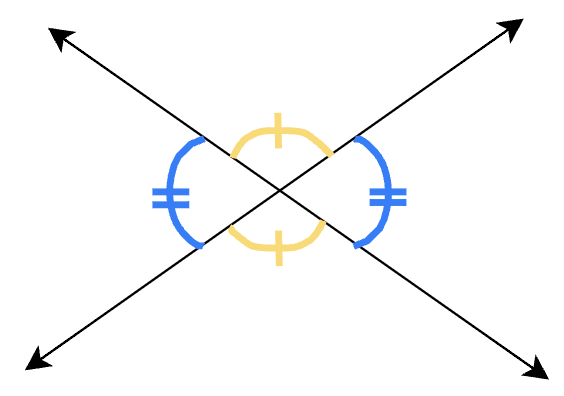
When working with parallel lines, remember:
- When two parallel lines are cut by a third line, the corresponding angles, exterior angles, interior angles, and alternate angles are all congruent.
To understand what this means, see the diagram below. The same-colored angles are all congruent.
- The interior angles on the same side are supplementary, meaning they add to 180°.

The ACT may give you a diagram with lines and expect you to identify one or more of these relationships quickly. Labeling and matching angles visually can help you avoid mistakes.
Practice Question
Two parallel lines are intersected by a transversal line. One angle measures (4x + 10)°, and its vertical angle measures (6x - 30)°. What is the value of x?
A) 10
B) 12.5
C) 20
D) 25
Correct Answer: C
Explanation: Vertical angles are congruent. Therefore, set the two angles equal to each other: 4x + 10 = 6x - 30. Solve to get x = 20
2. Triangles
The ACT frequently asks questions about triangles -- especially right triangles, which have one angle that is 90°. Here are the key tips to know when dealing with these questions:
- The interior angles of any triangle add up to 180°
- In an isosceles triangle, two sides and two angles are equal
- In an equilateral triangle, all sides and angles are equal (each angle is 60°)
- In a right triangle, the Pythagorean Theorem tells you that in any right triangle with sides a, b, and c, a2+b2 = c2
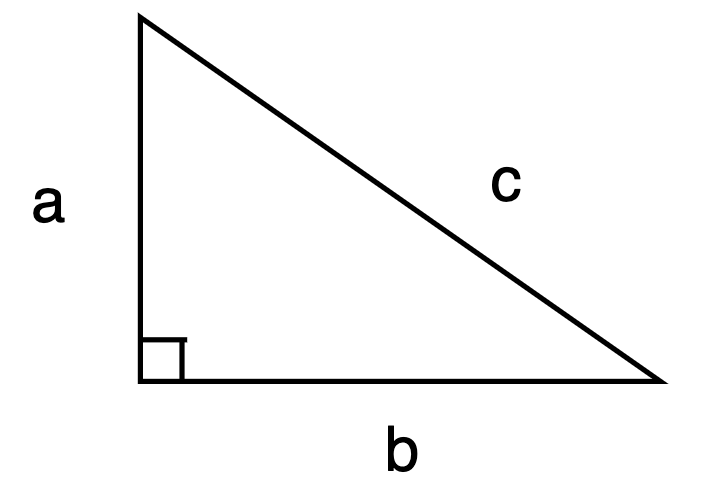
- It’s also important to memorize the properties of two special right triangles, which often show up on the ACT exam: the 45°-45°-90° triangle, and the 30°-60°-90° triangle.
In the 45°-45°-90° triangle, the two sides are equal to each other (represented by x), and the hypotenuse is equal to x * √2.
In the 30°-60°-90° triangle, if we represent the side opposite to the 30° angle as x, the side opposite the 60° angle is x√3, and the hypotenuse is 2x.

3. Polygons
The ACT often includes questions about polygons, or shapes with straight sides. A “regular polygon” is a polygon where all sides are the same length and all interior angles are equal. Think of a stop sign, which is a regular octagon with 8 equal sides. A trapezoid, on the other hand, is an irregular polygon where not all the sides are the same length.
When working with polygons, remember:
- If a regular polygon has n sides, the measure of one interior angle in the polygon is ((n - 2) × 180°) / n
- The sum of the interior angles is equal to (n - 2) × 180°
- The sum of the exterior angles is 360°
Practice Question
Each interior angle of a regular polygon measures 162°. How many sides does the polygon have?
A) 18
B) 20
C) 22
D) 24
Answer: B.
Explanation: The interior angle of a polygon with n sides is equal to ((n-2)×180)/n. Set that equal to 162 and solve for n: ((n-2)×180)/n = 162 -> (n-2)×180 = 162n -> 180n - 360 = 162n -> 18n = 360 -> n = 20
4. Circles
The ACT will often ask for the area, perimeter, and other properties of a circle. The following are the key rules to remember when encountering those questions. If you have a circle with a radius r and diameter d:
- Circumference (the perimeter of the circle): c =2r or c=d
- Area: a =r2
Things can get a little more complicated if you’re trying to calculate information about a slice (called a “sector”) of a circle. In this case, if you draw an arc with length s:
- Arc length: arc length = 360* 2r
- Sector area: area = (θ/360°)*r^2
- A tangent is a line that’s perpendicular to the radius at the point of contact
Practice Question
In a circle of radius 10, a central angle of θ radians cuts an arc of length 5π. What is the value of θ in radians?
A) π/2
B) π
C) 3π/2
D) 2π
Answer: A.
Explanation: The arc length is equal to rθ. Set that equal to 5π: 5π = 10θ → θ = π/2.
5. Coordinate Geometry
Coordinate geometry questions ask you to analyze shapes on the xy-plane. Be ready to use the slope, distance, and midpoint formulas in order to answer questions:
- Slope = (y2 - y1) / (x2 - x1)
- Distance formula: √[(x2 - x1)^2 + (y2 - y1)^2]
- Midpoint formula: ((x1 + x2)/2 , (y1 + y2)/2)
- Parallel lines have the same slope
- Perpendicular lines have slopes that are negative reciprocals
For circles plotted on a graph, remember the following rules:
- Equation: (x-h)2+(y-k)2 = r2
where (h, k) = center of the circle, r = radius

Practice Question
Triangle ABC has vertices A(1, 2), B(7, 2), and C(7, 6). What is the length of the altitude from point C to side AB?
A) 3
B) 4
C) 5
D) 6
Answer: B.
Explanation: AB is a horizontal line, so the height is the vertical distance from C to line AB: 6 - 2 = 4
If you need more help solving this question, or you want individualized guidance to help you in achieving a top score on the ACT, reach out to us for one-on-one support!
6. Area, Perimeter, Volume, and Surface Area
You should also expect to see questions about the area, perimeter of rectangles, triangles, and trapezoids, as well as the volume, and surface area of three-dimensional shapes. Surface area formulas are rarely tested but may appear occasionally.
Memorizing a few simple formulas is all it takes to solve these efficiently:

You should also know how to find the volume and surface area of a sphere:

Practice Question
A cube has a surface area of 384 square inches. What is the volume of the cube?
A) 512 in³
B) 576 in³
C) 729 in³
D) 864 in³
Answer: A.
Explanation: The surface area of a cube with side length s is 6s². This is because each side’s area is s², and there are six sides in total. Set that equal to 384: 6s² = 384 → s² = 64 → s = 8. Then, find the volume of the cube, which is equal to s^3. Volume = 8³ = 512.
7. Basic Trigonometry
On the ACT, all trigonometry questions involve right triangles and simple ratios like sine, cosine, and tangent. For right triangles with an angle θ, where the side opposite the angle is o and the side adjacent to the angle is a:

You can use the acronym “SOHCAHTOA” to remember these rules.
Additionally, know the following reciprocals of sine, cosine, and tangent:
- csc(θ) = hypotenuse/opposite
- sec(θ) = hypotenuse/adjacent
- cot(θ) = adjacent/opposite
It’s also useful to know the following simple identities and cofunctions:
- sin(x) = cos(90-x)
cos(x) = sin(90-x) - sec(x) = csc(90-x)
csc(x) = sec(90-x) - tan(x) = cot(90-x)
cot(x) = tan(90-x)
Also, it's important to know how the trigonometric functions are plotted on a graph. Take note of these graphs' horizontal lengths (the period) and the vertical distances between each peak (the amplitude):


Practice Question
In triangle ABC, angle C is a right angle. If sin(A) = 3/5, and the length of side AC = 12, what is the length of side AB (the hypotenuse)?
A) 15
B) 16
C) 18
D) 20
Answer: D
Explanation: sin(A) = opposite/hypotenuse = 3/5. This means that the ratio of the opposite to the hypotenuse is ⅗. If side AC (“opposite”) = 12, then we can find hypotenuse h by setting 12/h = ⅗ → 12 ÷ (3/5) = h → h = 20
8. Transformations and Similarity
You'll also see questions that focus on how shapes move, resize, and relate to each other. Know your transformation terms and how to compare sides and angles:
- Reflection: mirror image
- Rotation: turn around a point
- Translation: slide
- Dilation: scale up/down
- Similar figures: same shape, angles equal, sides proportional
- Congruent figures: same shape and size
Practice Question
Triangle DEF is similar to triangle XYZ. The sides of triangle DEF are 5, 12, and 13. If the shortest side of triangle XYZ is 15, what is the perimeter of triangle XYZ?
A) 39
B) 60
C) 78
D) 90
Answer: D.
Explanation: Pick two sides to first determine the scale factor. If we find the ratio of the two shortest sides, 15 in XYZ and 5 in DEF, we see that the scale factor is 15/5 = 3. In other words, the sides of XYZ are 3 times larger than those in DEF. Then, we can use this to directly calculate the perimeter: 3 × (5+12+13) = 3 × 30 = 90.
9. Interpreting Diagrams
Lastly, the ACT often tests how well you interpret diagrams and apply basic reasoning. These tips will help you think through these diagrams and answer the questions correctly:
- Don’t assume lines are parallel or angles are equal without labels or statements
- Pay attention to phrases like “figure not drawn to scale”
- Sometimes diagrams are intentionally misleading or incomplete. If necessary, verify them independently with your own calculations
Next Steps
ACT geometry is one of the most formula-driven parts of the exam. Memorize the essentials, practice applying them, and stay alert to traps. With the right preparation, geometry can become one of your highest-scoring areas on the ACT Math section.
Need more support? Reach out to us to get tailored, one-on-one tutoring to target your weak areas.


Master Desmos for the SAT: 7 Skills to Boost Your Math Score
Master Desmos for the SAT: 7 Skills to Boost Your Math Score
Bonus Material: DESMOS Quick Reference Guide
The DESMOS calculator built into the SAT can be a game-changer if you know how to use it correctly. Most students barely scratch the surface of Desmos's capabilities, costing them valuable time and lost points on test day.
Mastering Desmos could be the key in helping you achieve your goal score.
One of our SAT students raised their math score by over 100 points just by learning how to use Desmos strategically. With the right techniques, you can do the same. That’s a huge boost.
To optimize your SAT math score, download this reference guide to help you turn Desmos into your biggest test-day advantage.
Then, read on to learn the 7 fundamental skills you need to unlock the power of Desmos and the 7 common SAT questions that you can use Desmos to solve, helping you maximize your SAT math score and stay ahead of the curve.
Jump to section:
What is DESMOS?
7 Desmos Skills Every Student Should Master for the SAT
How to Use Desmos to Solve 7 Common SAT Questions
Next steps
What is DESMOS?
Desmos is the official graphing calculator built into the College Board's SAT. It’s accessible on every math question by clicking the “Calculator” icon in the Bluebook app.
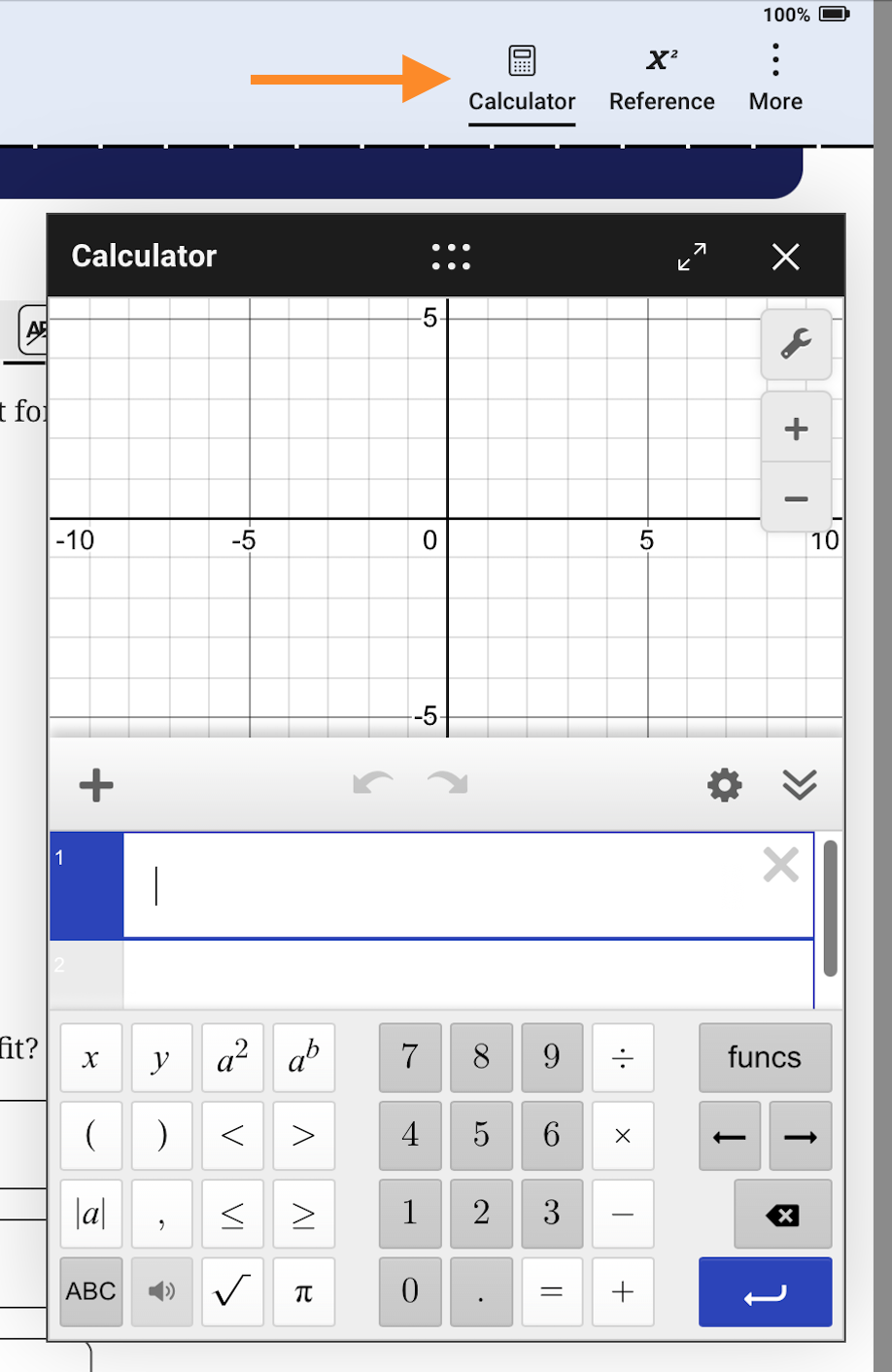
Approximately half of SAT math questions can be solved using Desmos alone! For instance, you can use Desmos to:
- Plot equations and instantly identify intercepts
- Solve linear and quadratic equations
- Graph and solve inequalities with visual shading
- Analyze systems of equations
- Find minimums, maximums, and parabola vertices
For other problems, Desmos can help you visualize and gut-check your answer. In this post, we’ll explain the most effective ways to use Desmos to give you the best strategic advantage.
If used correctly, Desmos isn’t just a calculator. It’s a tool to spot answers faster, check your work, and maximize your potential score. If you would like 1-1 support from an expert tutor, get in touch with our team to find the right match.
7 Desmos Skills Every Student Should Master for the SAT
To get the most out of Desmos on the SAT, it’s important to use the tool strategically.
These 7 fundamental skills will help you move faster, catch mistakes, and solve harder questions with confidence.
To see a fuller list of the most important Desmos skills to master by test day, download our Desmos cheatsheet here:
Skill 1: Using the Desmos Keyboard
Speed matters on the SAT. Mastering the Desmos keyboard saves time and prevents input errors.
Keyboard Tips:
- Exponents: Use ^ (Shift + 6), e.g., x^2
- Subscripts: Use _ (Shift + -), e.g., x_1
- Inequalities: Use <, >, <=, >=
- Absolute Value: Use |x| by typing Shift + \
- Tilde (~): Use Shift + ` (for regressions)
Let’s learn how to input some of the trickier math symbols using your keyboard, which looks like this on Mac and Windows:

To input an exponent, you’ll need to use the caret (“^”) symbol on your keyboard. For instance, xy is written as x^y. To produce this sign, press SHIFT + 6 on your keyboard.

To input a subscript, use the underscore (“_”) symbol on your keyboard. For instance, xy is written as x_y. The underscore symbol is written by using SHIFT + the dash button.

You’ll also want to know how to input the tilde (“~”) symbol, which will instruct Desmos to fit a table of values to an equation. The symbol is produced by using SHIFT + the mark button.

Another symbol that can be tricky to input is the absolute value sign. The absolute value bars are written by using SHIFT + forward slash.

It’s also important to know how to type the inequality symbols. For the less than symbol (“<”), use SHIFT+ the comma button. For the greater than symbol (“>”), use SHIFT+ the period button. To write greater than or equal to, type “>” and then “=” into Desmos. For writing less than or equal to, type “<” and then “=”.

Exercise: recreate these expressions in Desmos and find the intersection points:

Hint: To plot these expressions on the graph, click the circle on the left-hand side of each expression.
Answer: (6, 42) and (23, 161).
Skill 2: Inputting and Plotting Points
It’s also useful to know how to plot individual points using Desmos. This can help you quickly visualize things like the vertex of a graph or check solutions to inequalities.
To plot a point (5, 4), simply type that into Desmos:

If you click the circle on the left, Desmos will plot that point on the graph.

If you check the “Label” button, Desmos will label that point with its coordinates. You can also give the point a more meaningful label, like “vertex” for a parabola or “center” for the center of a circle, to help you keep track of a plotted point.
Plotting points is especially useful to quickly find things like radius and diameter of a circle.
If you set the point as a variable and click the circle on the left, you can also move the point around on the graph. This can be helpful for solving questions like finding a point (A, B) on a parabola when you’re only given one of the coordinates.

Exercise: recreate the following in Desmos:

Skill 3: Calculating Mean and Median
For SAT statistics questions, you can also use Desmos to quickly find the mean and median of a list. For instance, input this list, A, into Desmos. Note the importance of using square brackets.

You can quickly find the mean and median by writing out the following in the next sections:

The circle option on the left allows you to represent the mean and median as a fraction rather than a decimal.
Skill 4: Creating Tables and Finding Regressions
We can also use Desmos to create a table of values and produce a regression. This is particularly useful for finding the equation of functions when given two or more points.
Exercise: click on the ‘+’ button and fill in this table.


After creating the table, you can determine the slope and y-intercept for the resulting line. We can do this in line 2 by asking Desmos to produce a linear regression in slope-intercept form:
Note: make sure to correctly input the tilde (“~”) and subscripts.

Using Desmos in this way is crucial to solving questions quickly and saving precious time on the SAT. If you want to hone your Desmos skills even further, reach out to one of our tutors for one-on-one personalized guidance.
Skill 5: Working with Circles
We can also use Desmos to plot the equation of a circle. The graph will show the diameter’s endpoints at the top and bottom of the circle, as well as where the circle crosses the x and y axes.
Exercise: graph the following equation of a circle:

Label the top point ‘a’ and the bottom point ‘b’. Then, we can find the diameter by calculating the distance between the two endpoints. We can also find the center of the circle by finding the midpoint between them.

Skill 6: Using Sliders
With Desmos, you can use “sliders” to adjust variables of an equation and visualize how this impacts the resulting graph. This can help you tackle questions on topics like graph transformations, where you can instantly understand how changing a certain variable alters the resulting graph.
Here’s an example of how to use the slider. For the following parabola, we see that Desmos allows us to add a slider for the variable ‘a’.
If we click that button, a sliding scale pops up. Moving the slider helps us understand how the value of ‘a’ impacts the resulting graph. In this case, the larger ‘a’ is, the greater the y-intercept of the resulting parabola.

Skill 7: Navigating the Graph
It’s also important to know how to adjust the graph on Desmos to quickly identify things like x- and y-intercepts.
To adjust the frame on the Desmos graph, you can use your touchpad to zoom in and out. You can also use the “+” and “-” buttons on the side to zoom. If you want to view a more precise range, click the “wrench” icon on the side of the graph to manually set a minimum and maximum window for your axis.

If you create a table of points, you can use the “Zoom Fit” icon (a magnifying glass with a “+” symbol) on the side of the table to automatically fit the points to the screen.

Example: recreate these expressions in Desmos and find the intersection points

For a list of the important Desmos skills, download our cheatsheet here:
How to Use Desmos to Solve 7 Common SAT Questions
Now that we’ve covered 7 of the most fundamental skills needed for using the Desmos calculator, let’s put these skills to action.
Here are 7 common SAT math questions that Desmos can solve for you on test day.
If you want more in-depth guidance about how to best use Desmos to your advantage, reach out to our experienced math tutors for personalized, one-on-one support!
Question Type 1: Solving Equations
Desmos is extremely helpful in solving equations, helping you instantly determine things like x- and y-intercepts.
Example 1:

If we simply type this equation into Desmos, it provides both points where the parabola crosses the x-axis. Thus, we can see that the answer is 2.25, or 9/4. (You can also use Desmos to figure out that 9/4 = 2.25!)

Example 2:

Again, to solve this question, simply type in the equation to Desmos. The resulting graph shows that the positive solution is x = 9.

Question Type 2: Solving Systems of Equations
Desmos is also exceptionally useful in solving systems of equations.
Example:

To solve this, simply type in the two equations into Desmos. The resulting graph instantly tells you that the two equations intersect at (2,0).

Question Type 3: Finding Minimums and Maximums
We can also use Desmos to quickly find the minimum and maximum of a function.
Here’s an example of a question about a parabola:

If we type this equation into Desmos, we can see that the minimum of this parabola is at its vertex. In this case, the x-value of the vertex is 6.25.

Question Type 4: Graphing Inequalities
Graphing inequalities is another common question type where Desmos comes in handy. We can use Desmos to graph the inequalities, and the resulting graph is already shaded in with the values that satisfy the inequalities.
Example:

If we input this into Desmos, we get:

From there, we can figure out the missing coordinate in (x, 53). One method is by simply testing each x-coordinate by plotting it on the graph: (-9, 53), (-5, 53), (5, 53), (9, 53), and seeing if any of them falls in the region where the green and red shaded areas overlap.
However, a much more efficient way is to recognize that we know that y=53, so we can plot that onto the graph:

This helps us see that, when y=53, any value of x that falls inside the shaded region must be less than -8.75. The only answer choice that satisfies this condition is answer choice A, -9.
We can even plot (-9, 53) on the graph using Desmos to be certain that it’s the correct answer. It’s a little difficult to see, but the point does indeed fall in the shaded region.

It’s possible to use Desmos in a variety of ways to solve, visualize, and check our answers. By practicing using Desmos, you can turn this calculator into the key for maximizing your score.
To get a list of the most important skills to master, download our Desmos cheatsheet here:
Question Type 5: Finding Numbers of Solutions
Another question type that Desmos is great at solving is finding the number of solutions to a system of equations.
Example:

To solve this problem, plot the equations and use a slider for h to figure out the value for which the two lines are parallel -- in other words, they do not intersect, and thus have no solution.

Question Type 6: Regressions
One of the most powerful ways that Desmos can help you save time on the SAT Math exam is by running a regression on a list of points. This just means that Desmos finds the equation that fits a list of points.
To do this in Desmos, first create a list of points in a table format. Then, input the format of the equation you want to fit the points to.
Example:

To approach this problem, plot the two points (0,10) and (-2, 325/36) as a table in Desmos. Recall that we can insert a table in Desmos by clicking on the “+” button on the side of the screen.

Next, use a regression to determine the equation that fits the plotted points. Recall that we do this in Desmos by using a tilde sign in place of the “=”. Don’t forget to add the proper subscripts to your variables, writing them as y_1 and x_1.
This question dealt with an exponential function, but this strategy works with other types of regressions as well. For instance, if you want to fit the points to a line, you would input y_1 ~ mx_1 + b. If you’re looking to fit them to a quadratic equation, you would input y_1 ~ ax_1 + bx_1 + c.
Question Type 7: Solving Functions
Desmos can also help you quickly solve questions about functions on the SAT.
Example:
To solve this question, you can just plug everything into Desmos and it will output the answer:

With these examples, hopefully it’s clear how Desmos can be a superpower tool to help you ace the Math SAT. To make sure that you can use these skills in the most effective way on test day, make sure to practice these 7 key skills on the 7 types of SAT Math questions that we covered in this post.
Next Steps
Mastering these 7 fundamental Desmos skills and knowing the 7 common SAT Math questions to use them in will save you precious time on the SAT Math exam. Once you’re fluent in using Desmos, you’ll be able to tackle the questions with even more speed and confidence.
Want expert help? Our SAT tutors can show you exactly how to use Desmos efficiently and combine it with test strategy to hit your goal score.
Our SAT Prep tutors specialize in helping students master the exam with tailored strategies and a proven curriculum designed by test experts. Reach out to us if you’d like personalized 1-1 support.
SAT Algebra: The 22 Skills You Need for a Perfect Score
SAT Algebra: The 22 Skills You Need for a Perfect Score
According to the College Board, 35% of the questions on the SAT math section fall under the category “Algebra.” Another 35% fall under “Advanced Math,” which expands on the skills tested in the former.
We’ve compiled a list of 22 essential algebra concepts that students need to know on test day. This post focuses on the core skills that students must grasp to score well on SAT math, and at the end, we’ll provide tips about applying these skills to SAT questions.
In this post, we use simple examples to illustrate the key algebra skills needed for the SAT. See which skills you've already mastered and which ones need extra practice. If you would benefit from 1-1 support from an expert tutor, get in touch with our team to find the right match.
Jump to section:
Algebra Skills (1-7)
Algebra Skills: (8-14)
Advanced Math Skills: (15-22)
Next Steps
Algebra Skills
According to the College Board, about one-third of the questions on the SAT math section are categorized as “Algebra.” This umbrella mostly includes skills for solving linear equations and inequalities.
Most of these Algebra questions test skills for solving linear and nonlinear equations.
We’ll break this down further into the concrete skills that students need to know to master the questions in the “Algebra” category.
1. Combining Like Terms
Much of the SAT’s “Algebra” section involves knowing how to solve linear equations. In these questions, you’re usually working with a variable (like x). To solve an equation, you need to figure out which value for x would make the equation true.
For instance, you might be given an equation like 3x + 4x + 5 = 19.
To approach these kinds of questions, one of the most fundamental skills to understand is how to combine like terms.
Like terms have the same variable raised to the same power. The terms in an equation are separated by an operator, like an addition sign or subtraction sign. In the example above, 3x and 4x both have the variable x raised to the same power: 1. This means we can directly add their coefficients (the numbers in front of the variable) together, to get 7x . This simplifies our equation, making it the first step in solving it.
The same logic applies when combining like terms for variables that are raised to higher powers.
For example, take the expression 2x2 + x2. There are two terms, 2x2 and x2. In this case, we see that they both contain the same variable raised to the same power: x2. That means we can directly add the coefficients to get (2+1)x2 = 3x2.
2. Isolating Variables
After simplifying an equation by combining all the like terms, we need to isolate the variable we want to solve. This means moving the variable we’re interested in solving on one side of the equal sign, and moving everything else to the other side.
For example, when solving an equation like 2x + 3 = 7, the goal is to put x alone on one side of the equal sign.
To start, we want to move the 3 to the other side. On the left side, we can “undo” the addition of 3 by subtracting 3. Any operation you do on one side must be done on the other side as well. So we subtract 3 from both sides:
2x + 3 - 3 = 7 - 3
2x = 4
Now, to get x by itself, we have to deal with the 2. On the left side, because x is being multiplied by 2, we can “undo” this by dividing it by 2. And we do the same on the right.
(2x) / 2 = 4/2
x = 2
Now we have isolated the x and found that it equals 2.
3. Finding the Greatest Common Factor
One key strategy in solving linear equations is to find the greatest common factor (GCF), which helps us simplify an equation and make it easier to solve.
For example, if we have the linear equation 8x + 4 = 0, we can simplify it by noticing that every term in the equation can be divided by 4. In this case, 4 is the largest factor that satisfies this condition. (In other words, even though each term is divisible by 2, it’s not the greatest common factor.)
We can pull out this common factor, writing the equation as 4(2x+1) = 0. From there, we can divide both sides by 4, getting 2x+1=0. This makes our equation much easier to tackle. Using our skills in isolating the variable, we solve the equation:
2x + 1 - 1 = 0 - 1
2x = -1
x = -1/2
Thus, our solution is x = -1/2 .
4. Solving Linear Inequalities
Unlike equations, where students need to find one value for a variable, inequalities describe a range of values for a variable.
Still, solving inequalities is a lot like solving equations. First, we isolate the variable on one side of the inequality sign. To do so, add or subtract terms to move constants to the other side. Multiply or divide by a constant to get x alone.
Note: If you multiply or divide by a negative number, flip the inequality sign. This is a key difference from equations.
Once the variable is isolated, you can solve for x.
Example:
3x + 5 ≤ 11
Step 1: Subtract 5 from both sides:
3x ≤ 6
Step 2: Divide both sides by 3:
x ≤ 2
Thus the solution is x ≤ 2, meaning x can be any number less than or equal to 2.
5. Solving Linear Systems Using Substitution
For the SAT “Algebra” section, students not only need to understand how to solve one linear equation. They also need to know how to solve systems of multiple linear equations.
One key skill in solving linear systems is to use substitution. To solve systems of equations using this method, you solve one of the equations (usually the simpler one) for one variable and plug the result into the other equation. For example, let’s say we have the following system of two equations:
x + y = 5
2x - y = 4
We can take the first equation, x + y = 5, and solve for x. This gives us x = 5 - y. If we know that x = 5 - y, then we can take that and plug it in for x in the second equation, 2x - y = 4. This gets us:
2(5 - y) - y = 4
Then we solve for y:
10 - 2y - y = 4
10 - 3y = 4
-3y = -6
y = 2
Finally, we can plug our solution for y back into the first equation to solve for x:
x + 2 = 5
x = 3
Thus, our solutions to this system are x = 3 and y = 2.
6. Solving Linear Systems Using Elimination
You can also solve linear systems using a method called elimination. Using this method, instead of solving for one equation first, you combine the two equations together and solve that.
This is done by adding or subtracting the equations together to eliminate one of the variables.
Let’s say we have the system:
3x + 2y = 16
2x - 3y = -2
We can choose to eliminate x. To do that, we need to make sure the coefficients in front of x in both equations are the same. That way, we can cleanly subtract them from each other with nothing left over. In the first equation, the x coefficient is 3, while in the second, it’s 2.
Let’s make them both the same number by multiplying the top equation by 2 and the bottom one by 3. Remember, whatever you do to one side of the equation, you must do to the other.
2(3x + 2y) = 2(16)
3(2x-3y) = 3(-2)
This gives us:
6x + 4y = 32
6x - 9y = -6
Now, let’s eliminate the x terms by subtracting the bottom equation from the top:
6x + 4y = 32
-(6x - 9y = -6)
_________________
13y = 26
And solve to get y=2. Now, plug the solution for y back into either one of the original equations to find x.
3x + 2(2) = 16
3x + 4 = 16
3x = 12
x = 4
The solution to this system of equations is thus x = 4 and y = 2.
7. Solving Linear Systems With No Solution or Infinite Solutions
Sometimes we get systems of equations that have no solution or infinitely many solutions.
In linear systems with no solution, the two equations represent parallel lines that never meet. When simplified, the variables cancel out and you get a false statement like 0=5. This means there is no solution, or no points at which the two lines equal each other.
In linear systems with infinitely many solutions, the two equations represent the same line. When simplified, the variables cancel out and you get a true statement like 0 = 0.
This means there are infinitely many solutions, or infinitely many points at which the two lines equal each other.
8. Finding a Line’s Slope and Y-Intercept
When working with linear equations, students also need to understand how these equations are visualized as lines on a graph.
The point-slope form for a line is y = mx + b , where
m = slope
b = y-intercept
y = y-coordinate
x = x-coordinate
To find the slope, denoted as m, between two points on a line, assign one point to be (x1,y1) and the other as (x2, y2) and then plug the values into the slope formula:
m = (y1 - y2) / (x1 - x2 ) = "rise" / "run"
Equation of a line: y = mx + b
m = slope, b = y-intercept
Slope: m = (y1 - y2) / (x1 - x2 ) = "rise" / "run"
Midpoint: ((x1 - x2 / 2), (y1 - y2 / 2))

9. Finding The Point of Intersection Between Two Points
To find the point of intersection between two points on a line, figure out where they cross by setting the two equations equal to each other.
Example: Find the point of intersection between y = 2x +3 and y = -x + 1
Step 1: Make sure both lines are in point-slope form:
Line 1: y = 2x +3
Line 2: y = -x + 1
Step 2: Find where they intersect on the y axis by setting the two y’s equal to each other
2x + 3 = -x + 1
Step 3: Solve for x to find the x-coordinate of the intersection point
3x = -2
x = -⅔
Step 4: Substitute the x-coordinate into one of the equations to find the y-coordinate
y = 2(-⅔)+3
y = -5/3
The point at which the two lines intersect is (-⅔ , 5/3).
10. Finding The Equations of Parallel and Perpendicular Lines
Parallel lines are lines that never intersect. Two lines are parallel when the slope m of both lines are equal, but the y-intercepts are different.
For instance, lines y = 4/5x + 3 and y = 4/5x are parallel because they have the same slope and different y-intercepts
Example: Find the equation of the line that is parallel to y = 2x+1 that goes through point (2,2)
We can use point-intercept form to solve this question.
Step 1: Parallel lines have the same slope, m. According to point-intercept form, In the equation y = 2x + 1, m = 2
Step 2: Plug point (2,2) and m = 2 into y = mx + b to find b
2 = 2(2) + b
2 = 4 + b
-2 = b
Step 3: Plug it all back into point-slope form to identify the final equation.
y = mx + b
m = 2
b = -2
y = 2x - 2
11. Finding the Midpoint of Two Points on a Line
The midpoint of a line is the point that lies exactly halfway between two endpoints. Questions asking for the midpoint will usually provide two endpoints, and the midpoint can be found using the midpoint formula:
Midpoint of a line: ((x1 - x2 / 2), (y1 - y2 / 2))
Example problem: find the midpoint between endpoints (1,5) and (3, 11)
midpoint = ((x1 - x2 / 2), (y1 - y2 / 2))
midpoint = ((1+3)/2, (5+11)/2)
midpoint = (2, 8)
The midpoint between endpoints endpoints (1,5) and (3, 11) is (2, 8)
12. Finding the Distance between Two Points on a Line
he distance formula finds the distance between two points (x₁, y₁) and (x₂, y₂), on the graph.
d= √(x₂ -x₁)2+(y₂ -y₁) / 2
d = distance
(x₁, y₁) = coordinates of the first point
(x₂, y₂) = coordinate of the second point
Example: Find the distance between point A (1, 2) and B (9, 17)
Step 1: Write out the distance (d) formula
d= √(x₂ -x₁)2+(y₂ -y₁)2
Step 2: Plug in the coordinates where point A stands for (x₁, y₁) and B stands for (x₂, y₂)
d= √(9 -1)2+(17 -2)2
Step 3: Solve
d= (8)2+(15)2
d= 64 + 225
d= 289
d= 17
The distance between A and B is 17.
13. Evaluating Linear Functions
A function is a rule that defines a relationship between one variable (the independent variable) and another variable (the dependent variable). Functions can be represented by an equation that represents the relationship between an independent and dependent variable.
Function notation: a function is represented by f(x) , where f(x) is determined by any given x value.
Think of a function f(x) as a machine, where every x-value is an input that when inserted into the machine leads to a result: f(x). For example: if the x-value of a point is 5 and f(x)=x+5 , then f(5) = 10.
14. Evaluating Composite Functions
Composite functions are expressed in the form (f∘g)(x) = f(g(x)), where one function is defined by another function.
Example: solve (f∘g)(x)=f(g(x)) when f(x) = x + 2 and g(x) = 2x at x = 3
First, Plug x = 3 into g(x) = 2x
Hint: order of operations matters. (f∘g)(x)=f(g(x)) is different than (g∘f)(x)=g(f(x)) and will lead to a different result.
g(3) = 2*3
g(3) = 6
Next, plug the g(3) into (f∘g)(x)=f(g(x))
(f∘g)(x) = f(g(3))
(f∘g)(x) = f(6)
(f∘g)(x) = 6 + 2
(f∘g)(x) = 8
Advanced Math
The College Board estimates that another one-third of SAT Math questions are in the category of “Advanced Math.” This includes more high-level skills for solving linear equations as well as skills for solving nonlinear equations and inequalities.
We’ll break this down further into the skills that students need to know to master the questions in the “Advanced Math” category.
15. Evaluating Exponents and Radicals
Nonlinear equations are equations that contain variables raised to a power greater than 1. On a graph, this might look like a curve or a parabola. These equations will often have more than one value for x. The “solutions” simply tell you where the curve crosses the x axis on a graph.
Because these equations are nonlinear, many will contain a variable raised to a power. To solve them, students need to understand how to evaluate exponents and radicals.
Let’s start with the basics. An exponent tells us how many times to multiply a value by itself. For example, 23 = 2 * 2 * 2=8. Here, the 2 is called the “base” and the 3 is called the “exponent.” By the same token, x4 = x * x * x * x.
A radical is the “reverse” of an exponent. It is the value that, when multiplied by itself some number of times, gives you the value under the root symbol. For instance, to simplify ∛8 , ask: which number, multiplied by itself 3 times (the “degree”), would give us 8 (the “radicand”)? As we found above, the answer is 2.
Radicals can be written as exponents, and vice versa. For example, the expression ∛8 can be written using an exponent as 81/3.
16. Understanding Exponent Rules
To begin solving equations with exponents and radicals, it’s important to follow the exponent rules:

These rules guide us in working with exponents and radicals.
For example, to simplify an expression like 3(5x-3x)-2, we first combine the like terms within the parentheses to get 3(2x)-2. Then we evaluate the exponent. Using the negative exponent rule and remembering to distribute the exponent to all the items inside the parentheses, we get 3(1/4x2). Finally, we evaluate the multiplication to get 3/4x2 as our final solution.
17. Solving Quadratic Equations
Once we understand what exponents and radicals are and what rules we need to follow when working with them, we can start to solve nonlinear equations.
A common form of nonlinear equation is a quadratic equation, which contains a variable raised to the power of 2. Quadratic equations follow the basic format ax2 + bx + c and a ≠ 0. When graphed, quadratic equations form the shape of a parabola.
A parabola is a curve that is approximately u-shaped. Because the parabola is symmetrical, there is a single point called a vertex at the deepest point of the “curve” where the parabola begins to change direction. The vertex is located on the axis of symmetry, a line that cuts the parabola in half.
X-value of vertex (“axis of symmetry”): x = -b / 2a
To find the vertex of a parabola, use the formula x = -b / 2a to find the x-coordinate of the vertex, then plug that value back into the original equation of the parabola to find the y-coordinate.
Vertex form: f(x) = a(x-h)2 + k
(h, k) is the vertex, axis of symmetry is x=h
a indicates the direction and width of the graph
The points at which the quadratic crosses the x-axis are called the solutions or roots of the quadratic. Find these points by setting the parabola equation to 0.
18. Factoring Quadratics
A key skill in solving quadratics is factoring. To factor quadratic equations of the form ax2 + bx + c, look for two numbers that multiply to ac and add to b.
For example, to factor x2 + 5x + 6, look for two numbers that multiply to 6 and add to 5. These numbers would be 2 and 3. Then you can rewrite x2 + 5x + 6 = (x+2)(x+3). Test this out the distributive property to see how both sides of the equal sign are equivalent to each other.
19. Factoring by Completing the Square
If a quadratic equation isn’t factorable by the method above, there’s still another way of factoring: by completing the square. To do this, we rely on two rules:
Sum of squares: (a + b)2 = a2 + 2ab + b2
Difference of squares: (a-b)2 = (a+b)(a-b)
Example 1:
f(x) = 9x2 - 4 (difference of 2 perfect squares)
9x2 - 4 = (3x)2 + (2)2
This is of the form (a - b)2 = (a+b)(a-b).
Hence we factor the equation 9x2-4 = (3x+2)(3x-2)
Example 2:
f(x) = 4x2 + 12x + 9 (sum of 2 perfect squares)
4x2 + 12x + 9 = 2x2+ 2(2x)(3) + 32
This is of the form (a + b)2 = a2 + 2ab + b2:
(2x)2 + 2(2x)(3) + (3)2 = (2x+3)2
Hence, (2x + 3)(2x + 3) is the factored form of f(x) = 4x2 + 12x + 9.
20. Evaluating Quadratics using the Quadratic Formula
If neither of the two methods above work, we can solve any quadratic equation using the quadratic formula.
Quadratic formula:

We can also use the quadratic formula to determine how many solutions there are for a given equation. Certain quadratic equations have no solutions (equation does not pass x = 0).
The discriminant, b2 - 4ac, the part of the quadratic formula underneath the root, determines the number of solutions:
b2-4ac > 0: Two real solutions.
b2-4ac = 0: One real solution.
b2-4ac < 0: No real solutions (complex numbers)
21. Solving Systems of Quadratic Equations
In a quadratic system with one solution, the two quadratic curves intersect at exactly one point.
Example:
y = x2 + 2
y=(x - 1)2
In a quadratic system with two solutions, the two quadratic curves intersect at exactly two points.
Example:
y = x2 + 2
y=(2x - 1)2
In a quadratic system with infinitely many solutions, the two quadratic curves are identical.
Example:
y = x2 + 4x + 4
y=(x + 2)2
In a quadratic system with no solution, the two quadratic curves do not intersect.
Example:
y = x2 + 2
y= x2 - 3
22. Solving Systems of Quadratic Equations
Solving nonlinear inequalities is similar to solving linear ones, except you might get more than one answer for x. As a result, you need to identify the intervals on the number line broken up by each of the values for x and test each interval to see if the inequality holds true in that range.
Let’s say we have the following quadratic inequality:
x2 - 5x + 6 ≤ 0
First, let’s factor the left hand side:
(x-2)(x-3) ≤ 0
“Solving” it, we get:
x1 = 2, x2 = 3
In this case, x1 and x2 break up the number line into 3 intervals: −∞ to 2, 2 to 3, and 2 to ∞. You can represent the intervals like this: ( −∞,2], (2,3), [3,∞). The “(“ means the number itself is not included, while the “]” indicates that it is included.
Step 2: Pick an easy number in each interval to test. For the interval ( −∞,2], we can pick 0. For (2,3), we can pick 5/2. For [3,∞), we can pick 6. Plug in each number for x and see if the inequality holds.
x = 0: 0 - 0 + 6 ≤ 0 → FALSE
x = 5/2: 25/4 - 25/2 + 6 = -5/4 ≤ 0 → TRUE
x = 6: 36 - 30 + 6 ≤ 0 → FALSE
So we know the inequality is true in the interval between (2,3). Then, make sure to test the x1 and x2 themselves to see if the inequality is true for those numbers.
Solution: the inequality is true for interval [2,3].
Next Steps
Understanding these 22 core skills for SAT Algebra will give you the foundation you need for a top score. Once you master these skills and learn how to apply them, you should be able to walk into test day with confidence.
If you’re aiming for a top SAT Math score but find yourself stuck, personalized guidance can make all the difference. Our SAT Prep coaches specialize in helping students master the test through targeted strategies and a proven curriculum designed by test experts. Reach out to us if you'd like tailored 1-1 support.
At the end of the day, SAT success comes down to not just working hard, but working smart. As you start preparing, be sure to make a study plan that hones in on all of the key topics that you will be tested on during the exam.
ACT Math Formulas: Everything you need to memorize for the ACT
ACT Math Formulas: Everything you need to memorize for the ACT
Bonus Material: 68 ACT Math Formulas Cheatsheet
Scoring well on the ACT is an important part of impressing colleges and securing an admissions offer.
The Math section of the ACT is notoriously tough, and students need to have memorized these 68 essential math formulas in order to earn a high score on the test.
While other test prep sites might simply dump all of these formulas into a list, we’ve used our decades of expertise in ACT prep to indicate which formulas students really need to know for test day.
Read on for an introduction of how to use each key formula. Then download all of the ACT math formulas as a handy guide.
Math formulas in this post:
Algebra: Linear Functions
Exponential Operations
Algebra: Polynomial Functions
Geometry: Angles
Geometry: Triangles
Geometry: Circles
Geometry: Perimeter, Area, and Volume
Trigonometry
Statistics and Probability
Advanced Algebra
Memorizing ACT Math Formulas
Unlike the SAT and other standardized tests that students may have taken, the ACT does not provide students with any resources during the test.
For this reason, students need to memorize a number of math formulas in order to do well on the ACT.
The ACT provides their own formula sheet, but not all of the formulas they list are equally important. We’ve used our decades of expertise with the ACT to organize the formulas so that students can focus on what really matters for the test.
Sometimes the ACT provides more obscure formulas (like the trigonometric identity formula or the volume of a cone) in the text of the individual question. In our downloadable guide, we include only the most important formulas to know for the ACT.
There’s no point in wasting time on “formulas” that don’t actually appear on the ACT!
Use active memorization techniques to make sure that your knowledge of these formulas is rock-solid. Practice copying these formulas out onto a blank sheet of paper from memory. Try explaining the formulas to a friend, or even a pet or inanimate objects (a technique used by engineers at Google).
Of course, it’s important that students feel comfortable not just repeating the formula itself, but implementing the formula on real ACT problems. The best way to hone this skill is to practice with real ACT math problems and real ACT tests. Our Ivy-League ACT tutors can help students practice with the best materials available and learn from their mistakes to boost their test scores.
Algebra: Linear Functions
One of the most common concepts on the ACT is linear equations and functions. The equation for a line is y = mx + b. In this equation, m represents the slope of the line, while b represents the y-intercept. As with all equations, x is the input and y is the output. You may also see this equation written as f(x) = mx + b. This means essentially the same thing!
Equation of a line: y = mx + b
m = slope, b = y-intercept
Slope: m = (y1 - y2) / (x1 - x2 ) = "rise" / "run"
Midpoint: ((x1 - x2 / 2), (y1 - y2 / 2))
We can find the slope of a line by dividing the “rise” by the “run,” or how much the line travels up and down divided by how much the line travels side-to-side. The formula for this is m = y1 - y2 / x1 - x2, where (x1, y1) and (x2, y2) are two different points on the line. It doesn’t actually matter which point you assign to be (x1, y1) vs (x2, y2).
Students should definitely take a few moments to memorize the quadrants of the coordinate plane. This is typically an easy, quick problem if you know which one is which!

Students should also know how to find the midpoint on a line. It’s helpful to think about the midpoint as an average — the middle — between two points. Just like any other time that we calculate an average of two values, we add the two x-values together and divide by two, and then do the same for the y-values. That means that the formula for this concept is (x1 + x2 / 2, y1 + y2 / 2).
Midpoint of a line: ((x1 - x2 / 2), (y1 - y2 / 2))
Some textbooks will make students memorize a separate equation for the distance formula, which finds the distance between two points on the coordinate plane. If students already know this formula, that’s fine. However, we don’t recommend spending time memorizing it, because it’s actually just an application of the Pythagorean Theorem, which we’ll cover below.
To recap, here are the formulas students need to know for linear equations and functions:
- Equation of a line: y = mx + b
- Slope: m = (y1 - y2) / (x1 - x2)
- Quadrants of the coordinate plane
- Midpoint is ((x1 + x2 / 2), (y1 + y2 / 2))
- Bonus: distance formula, but you don’t need to memorize it because it’s just an application of the Pythagorean Theorem
Exponential Operations
We made this a separate section because we know from decades of coaching students on the ACT that many students have a fuzzy knowledge of exponential operations.
These are key concepts for math, and usually with a bit of targeted practice students can gain several ACT points just by solidifying their knowledge of how to work with exponents.
So for example, students should be able to easily simplify the following expressions with exponents:

Algebra: Polynomial Functions
Of course, many problems will use exponents in equations or functions. These are polynomial functions.
One of the most common types of polynomial functions on the ACT is the quadratic function, which makes a parabola shape when graphed on the coordinate plane.
There are two main equations for a quadratic function, and both can be incredibly useful, depending on the context.
Standard form: f(x) = ax2 +bx + c
c = y-intercept
The first form of the quadratic function is standard form: ax2 + bx + c = 0. In this equation, a, b and c are known values. Furthermore, a can't be 0. If a is positive, the graph of the parabola will open upwards. If a is negative, the graph of the parabola will open downwards. Higher values of a will make the parabola narrower, while values between -1 and 1 will stretch the parabola horizontally.
Positive a = the graph opens upwards.
Larger a = the graph is narrower.
Negative a = the graph opens downwards.
Smaller a = the graph is wider.

When our quadratic function is in standard form, we can use the formula h = -b / 2a to find the x-value of the vertex. (This is also the axis of symmetry.) Once we have this, we can plug in h for x in the equation to find the y-value of the vertex.
X-value of vertex (“axis of symmetry”): h = -b / 2a
If this same equation is rearranged (using algebra) into this format, we can learn other things from the equation:
Vertex form: f(x) = a(x-h)2 + k
(h, k) is the vertex, axis of symmetry is x=h
a indicates the direction and width of the graph
In this form, whatever numbers end up in the h and the k positions tell us what the vertex is for the parabola. That’s the lowest or highest part of the curve.
The vertex form of a quadratic function is incredibly powerful, because we can immediately know the location of the vertex without doing any other work!
Rarely, the ACT will also expect students to know the Quadratic Formula. That’s perhaps the most complicated formula for the ACT:
Quadratic formula:
when ax2 + bx + c = 0
a, b, c = constants, where a ≠ 0
x = the unknown
Ideally, students have this memorized. However, in our experience, usually problems can be solved without the Quadratic Formula, by doing some clever factoring (sometimes using the “completing the square” approach instead. So if students are tight on time, don’t prioritize memorizing this complicated formula.
Students should also know how to match the graph of a polynomial function with an equation. The most important thing to know about this is that the graph will have one fewer “turning point” than the value of the biggest exponent. So the graph of an equation with x^2 will have one turning point, the graph of x3 will have two turning points, the graph of x4 will have three turning points, and so on.
Finally, students are expected to know the equation of a circle when graphed on the coordinate plane:
Equation of a circle: (x-h)2+(y-k)2 = r2
(h, k) = center of the circle,
r = radius

This is typically necessary for one problem on each ACT Math section — so it’s lower priority than the essential rules of linear functions and basic geometry, but it will reliably be relevant on every ACT.
To recap, here are the formulas we need for polynomial functions:
- Quadratic function standard form: ax2+bx+c = 0
- Find the x-value of the vertex (also the axis of symmetry) from standard form: h = -b/2a
- Find the zeros / solutions f and g by factoring from standard form: (x-f)2+(y-g)2=0
- Quadratic function vertex form: y=a(x-h)2+k, where (h, k) is the vertex
- Graphing polynomial functions: the graph will have one fewer “turning point” than the value of the biggest exponent
- Circle function: (x-h)2+(y-k)2=r2, where r is the radius and (h, k) is the center
- Bonus: quadratic formula, which is a classic but tends not to be necessary for ACT problems
Geometry: Angles
Students familiar with the SAT may be surprised that the ACT has significantly more geometry than the SAT.
The most common geometry formulas or rules that students need to know involve angles. Students need to know that supplementary angles add up to 180 degrees, and complementary angles add up to 90 degrees.
Vertical angles (also called opposite angles) are always congruent:

Adjacent angles are supplementary and add up to 180 degrees:

When two parallel lines are crossed by a third line, the corresponding angles, exterior angles, interior angles, and alternate angles are all congruent.

Geometry: Triangles
A key rule about triangles is that all of the interior angles of a triangle will add up to 180 degrees.
There are a handful of “rules” that seem a bit self-explanatory if you take a pencil and paper and try drawing some triangles. For example, any two sides of a triangle must sum to be greater than the third side, and the biggest angle is always the longest side of the triangle. No single angle of a triangle can be more than 180 degrees.
Right triangles (triangles where one angle is 90 degrees) are very important in ACT geometry. One of the most commonly-used formulas for working with the side lengths of triangles is the Pythagorean theorem. This formula states that a2 + b2 = c2, where a and b are the lengths of the shorter sides of a right triangle and c is the hypotenuse (the longest side).
Pythagorean theorem = a2 + b2 = c2

While the Pythagorean Theorem can be used to re-derive many individual triangles, it can be very handy to recognize three famous right triangles in particular.
The first of these famous triangles is the 3-4-5 triangle, referring to a right triangle with side lengths of 3 and 4 and a hypotenuse with length 5. On the ACT, students are more likely to see a slightly-disguised version of this famous triangle, like 6-8-10 or 12-16-20.
The other two special right triangles make reference to the angle measurements.
The first is the 45-45-90 triangle. This could also be described as an isosceles right triangle, because two of the angles and side lengths are identical. If the sides of the triangle are x, then the hypotenuse of the 45-45-90 triangle is x times √2.

The last special right triangle is the 30-60-90 triangle. If the shortest leg of this triangle is x, then the other leg is x times √3, and the hypotenuse is 2x.

While there is often a longer way of solving problems involving special triangles, if students can quickly spot the special triangle, they’ll have a huge advantage and be able to solve the problem much more quickly.
If triangles (or any other shapes) are similar, that means that their angles are the same, and their side lengths are proportional to each other.
The formula for the area of a triangle is the length * width * ½. This makes sense if you think about it, because two triangles together will make up a rectangle (for which the area is length * width).
Area of a triangle = ½ * length * width
So to recap,
- The most important formula for triangles is the Pythagorean Theorem, a2 + b2 = c2.
- All of the angles of a triangle will add up to 180 degrees.
- Students should also recognize the special right triangles and know their proportional side lengths: the 3-4-5 triangle, the 45-45-90 triangle, and the 30-60-90 triangle.
- The area of a triangle is ½ * length * width.
Geometry: Circles
Questions about circles also appear frequently on the ACT.
There are a small handful of circle formulas that are absolutely essential to know for the ACT. There’s no way to re-derive these formulas a longer way on the text — either you know them, or you don’t.
Fortunately, the most important circle formulas are very short!
The radius is the distance from the center of the circle to the outer edge.
No matter which direction you draw the radius, it will always be the same.

The diameter is the distance all the way across the circle at the widest point — it’s the same as 2 * the radius.
Diameter = 2 * radius

Students need to know that for a circle with radius r, the perimeter of the circle will be equal to 2πr, and the area of the circle will be equal to πr2.
Perimeter = 2πr
Area = πr2
Remember that π (a symbol which is pronounced pi, like “pie”) is a special number that goes on forever, but can be estimated with 3.14. Don’t worry about memorizing digits of π for the ACT, because students will always be able to use their calculators, which always have π stored.
Now, in addition to being able to find the radius, diameter, area, and perimeter of a circle, students should be able to work with arcs and sectors.
Central angle = corresponding arc

Meanwhile, inscribed angles (angles that hit the back wall of the circle) will be half of the measure of the corresponding arc or central angle. No matter where you place the inscribed angle, if the endpoints on the circle are the same, then it will always have the same measure:
Inscribed angles = ½ * corresponding arc

One cool trick is that any angle subtended by the diameter of the circle will be 90 degrees, though this fact is rarely necessary for the ACT:

Technically, there are a few more equations for these concepts that students can memorize:
Length of an arc:
arc length = θ*r
where θ = central angle in radians, r = radius
Area of a sector:
area = (θ/360°)*r2
where θ = central angle in degrees, r = radius
However, for both of these concepts, it’s possible to work them out using logic and the knowledge that the circle is made up of 360 degrees (or 2π radians). For that reason, we don’t recommend prioritizing memorizing these formulas.
Students will also occasionally be expected to convert between degrees and radians. It’s not necessary to have the entire unit circle memorized. The essential thing to know is that 180 degrees = π radians.
To recap, the important circle formulas to know for the ACT are:
- Circle diameter: d = 2πr
- Circle area: A = πr2
- Circle has 360 degrees
- Converting between degrees and radians: 180 degrees = π radians
- An inscribed angle has half the measure of the corresponding central angle or arc
- Bonus: any angle subtended by the diameter of the circle will be 90 degrees
- Bonus: length of an arc
- Bonus: area of a sector
Geometry: Perimeter, Area, and Volume
There are a handful of other formulas for perimeter, area, and volume that may be useful on the ACT. However, as long as students know that the general way to find area is to multiply length by width, and that for volume you just need to multiply the area by the height (to make the shape three-dimensional). Similarly, the area of a three-dimensional shape can almost always be figured out on the test by drawing a little picture.
That means that students can memorize the following formulas individually, but it’s also possible to puzzle them out with logic on the test:

For example, if students encounter a trapezoid on the test, they can simply split it into two triangles and a rectangle in the middle. Sure, it’s possible to apply a special trapezoid formula, but it’s totally unnecessary.
That said, it is good to know the formula for the area and volume of a sphere, which is not reasonable to figure out with logic. (We covered the perimeter and area of a circle above — those are definitely key formulas to know for the ACT!)
Volume of sphere = (4/3)πr3
Surface area of sphere = 4πr2

In theory, students might want to also know the formula for the area and volume of a cone. However, in practice, the ACT usually gives students these more obscure formulas as part of the question.
Area of cone = πr2 + πrs
Volume of cone = (πr2h) / 3

It’s also good to know that the interior angles of a polygon with n sides sum up to ((n-2) x 180°)/n. If students forget this formula, they can remember two familiar shapes: a triangle (with 3 sides) sums up to 180°, and a square (with 4 sides) sums up to 360°. Following the pattern, just add 180° for each new side on the polygon!
A polygon with n sides sum to ((n-2) x 180°)/n.
So to recap, here are the formulas for perimeter, area, and volume that students should know for the ACT:
- Area of a rectangle
- Area of a rectangular prism
- Volume of a rectangular prism
- Area of a triangle
- Area of a triangular prism
- Volume of a triangular prism
- Area of a sphere
- Volume of a sphere
- Interior angles of a polygon with n sides are ((n-2) x 180°)/n
- Bonus: area of a cone
- Bonus: volume of a cone
Trigonometry: SOHCAHTOA
The ACT does include some questions about basic trigonometry — notably more than the SAT does, for students familiar with the SAT.
The most crucial trigonometry formulas for students to know are sine, cosine, and tangent:


Of course, most students know the SOHCAHTOA acronym for this information that makes it much easier to remember the difference between sine and cosine.
Students should also be familiar with cosecant, secant, and cotangent:

There are a handful of more advanced trigonometric concepts that regularly appear on the ACT. Students should know how to graph sine, cosine, or tangent.

They should know how to identify the period and amplitude of a wave function.

Students should know where sin, cos, and tan are positive/negative on the coordinate plane.

More rarely, students might find questions with trigonometric functions like sin2θ + cos2θ = 1 or sin / cos = tan. However, these will usually be given to students in the question, so it’s not necessary to have them memorized.
To recap, the most important trigonometry formulas that will definitely be on the SAT are SOHCAHTOA. More advanced trigonometric concepts are fair game, so it’s a good idea to be familiar with the rest of these formulas, especially for ambitious students who are trying for a high score on the ACT.
Statistics and Probability
In addition to algebra and geometry, the ACT also tests basic skills in statistics and probability.
Students should be comfortable working with percentages. They should know that the percent is equal to the part divided by the whole, multiplied by 100%.
X% of y = (x/100) * y OR (y/100) * x.
The “percent change” is the value of the change divided by the original value.
Percent change = change / original
The most important statistical formula is a simple one: the average (or mean) is equal to the sum of the terms divided by the number of terms.
Mean = (sum of terms) / (# of terms)
The range of a dataset is the biggest value minus the smallest value.
Range = (largest value) - (smallest value)
The probability of an event is the number of desired terms divided by the total number of terms.
Probability = (# of desired terms) / (# of terms)
The probability that an event does happen plus the probability that an event doesn’t happen always adds up to 1.
(probability event happens) + (probably event doesn't happen) = 1
The probability of two separate events both happening is equal to the probability of the first event multiplied by the probability of the second event. In order to find the probability of more than two separate events all happening, simply continue the pattern and multiply all the individual probabilities together!
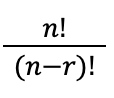
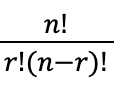
More rarely, the ACT may ask questions about permutations and combinations.
Permutations:
Combinations:
Advanced Algebra
There are a handful of additional concepts that can appear on the ACT Math section, especially in the last 20 problems, which are always the hardest and the most advanced.
There are often problems involving exponential growth functions. Students should know how to set up these functions:
Exponential growth:

It’s also possible for questions about logarithms to appear on the ACT. The definition of logarithms is that if loga(b) = c, then ac = b.
If loga(b) = c, then ac = b.
If it’s necessary to change the base of a logarithm, then use the change of base rule:

Rarely, there may be questions about arithmetic sequences or geometric sequences on the ACT. The formulas for these are:
Arithmetic sequence: tn = t1 + d(n - 1)
Geometric sequence: tn = t1 * r(n-1)
Finally, every few tests there’s a question about matrices. Students who are chasing a high score on the ACT should make sure that they know how to add and multiple matrices:
Given two matrices A and B

The sum C=A+B is:

The product C=A*B is:

Not sure how to work with these more advanced topics? Our Ivy-League tutors have helped thousands of students boost their math knowledge for the ACT. One-on-one tutoring is the ideal setting for filling in any holes in a student’s math knowledge.
Next Steps
Now that you’ve seen all of the important formulas and rules that you need to know for the ACT, the next step is to make sure you’ve memorized them thoroughly. Download our handy guide with all of the math formulas necessary for the ACT.
Learning these ACT formulas is a crucial step of the ACT prep process. The next step is to practice implementing these formulas with practice on real ACT math problems.
Not sure how to practice these ACT math concepts? Hit a plateau with your practice? Through targeted practice and carefully-planned lessons, our experienced ACT tutors have helped thousands of students boost their ACT scores.
Regardless of whether you’re filling in some holes in your general math knowledge (especially common these days after interruptions in schooling due to Covid) or chasing that high score in the 30s, our Ivy-League tutors will match your individual needs.
Schedule a short educational consultation to get started with high-quality tutoring.
Related Articles
The Best ACT Tutoring
Average ACT Scores: The Latest Data
SAT vs ACT
Converting SAT to ACT Scores (and vice versa)
The Best SAT Prep Courses
13 ACT Grammar Rules
Hardest SAT Math Problems
The Best SAT Online Tutoring
When should you take the SAT or ACT?
How to Proctor Your Own ACT Practice Test
Your Complete ACT Guide for 2024