
Updated November 9, 2026
SAT vs ACT: Which Test is Easier to Get a High Score On?
Expert guidance provided by Ro (10+ years’ experience in test prep and college essay editing) and reviewed by Mike Kleynman (PhD in English, 10+ years’ experience coaching test prep and college admissions).
Which admissions test will give you the most competitive college application: the SAT or the ACT?
It feels like anytime you ask someone, the answer is, “it depends.”
But based on what we’re seeing with our own students, we think that most students will benefit from taking the ACT over the SAT.
At PrepMaven, we’ve been working with both the ACT and SAT for over twenty years, and we’ve been tracking how these tests have changed significantly over that time. Because we’ve worked with so many students, we’ve also noticed some recent trends in how students score on these tests.
Below, I use my experience in test prep to explain why most students would benefit from taking the ACT instead of the SAT.
No matter which test you end up taking, whether you’re aiming to qualify for a merit scholarship or to be competitive in Ivy admissions, a good tutor will be able to help you tailor your prep plan to your goals.
Jump to section:
SAT vs ACT: side-by-side comparison
Why the ACT is Often Easier
1. Math is a smaller part of your overall ACT score than your SAT Score
2. The SAT tests more, and harder, vocab
3. The SAT has more complex Reading questions
4. The ACT gives you less time per question—but that’s reflected in the question difficulty
5. You can still get a perfect ACT score with a lower score on one section
When the SAT Might be Easier
Next steps
SAT vs ACT: side-by-side comparison
First things first: what are the key differences between the SAT and ACT?
| SAT | ACT | |
| Sections | – Math – Reading & Writing | – Math – Reading – English – Science (optional) – Essay (optional) |
| Score Range | 200-800 per section. 400-1600 total score | 1-36 per section, 1-36 total score |
| Total score calculation | 50% Math, 50% Reading & Writing | 33% Math, 33% Reading, 33% English |
| Choice of sections | No choice | Science and Essay sections are optional |
| Adaptive? | Yes—tests get harder or easier based on your performance | No, all students answer the same questions |
| Total Time | 2 hours and 14 minutes | 2 hours and 5 minutes (add 40 minutes each if taking the Science and/or Essay sections) |
| Time per question: Math | 1 minute, 35 seconds | 1 minute, 7 seconds |
| Time per question: Reading & Writing | 1 minute, 11 seconds | Reading: 1 minute, 7 seconds English: 42 seconds |
| Multiple Choice | Mostly, but Math also includes write-in answers | Fully multiple-choice (except the Essay) |
| Superscoring allowed? | Yes | Yes |
| Calculator policy | Built-in DESMOS calculator or your own calculator | Bring your own approved calculator (see calculator policy) |
| Test format | Digital | On paper or digital |
When you’re deciding which test to take, a few of these points are especially important:
- Do you want Math to weigh more or less heavily in your total score?
- Do you do better with on-paper testing versus digital?
But don’t just look at this list. You might notice that the SAT gives you more time per question and assume that that makes it an easier test—but that’s not accounting for the difficulty of the questions. We’ll get into that below.
Why the ACT is Often Easier
In my experience as a test-prep tutor who helps students with both the SAT and the ACT, the ACT is often easier for many students.
Yes, it depends on your specific strengths and weaknesses, and the SAT may be easier for you personally (we’ll get into that in just a minute). But for most students, a high ACT score is within easier reach than a 1500+ SAT score.
Here’s why:
- Math is a smaller part of your overall ACT score than your SAT score.
- The SAT tests more, and harder, vocab.
- The SAT has more complex Reading questions.
- The ACT gives you less time per question—but that’s reflected in the question difficulty.
- You can still get a perfect ACT score with a lower score on one section.
Another bonus: Because the ACT has not switched to adaptive testing or gone fully digital, older test prep materials are still useful for your ACT study. If you take the SAT, any materials over a couple of years old will be much less useful for your test prep (though you can still use them to practice test content).
Let’s get into it.
1. Math is a smaller part of your overall ACT score than your SAT score
For each test, you’ll receive a score for each section, plus your total score. On the ACT, this only includes the required sections, so any Science or Essay scores will not be factored into your total score.
On the SAT, Math is 50% of your total score. On the ACT, Math is just 33% of your score. That’s because the ACT counts Reading and English separately.
Here’s an example of how that could look for a student who’s less strong in Math than in Reading/Writing/English:
SAT Math score (200-800) | SAT Reading & Writing Score (200-800) | Overall SAT Score (400-1600) |
| 600 | 720 | 1320 |
ACT Math score (1-36) | ACT Reading Score (1-36) | ACT English Score (1-36) | Overall ACT Score (1-36) |
| 30 | 34 | 35 | 33 |
You can see that on the ACT, it’s easier to compensate for a lower Math score. Of course, if you happen to excel at math, this might not be a reason to take the ACT—but for the majority of students, it’s a plus. Also, ACT Math is fully multiple-choice, while SAT Math includes some open-answer questions.
ACT math does cover certain topics that aren’t tested on the SAT, like matrices and logarithms. To see exactly how your knowledge lines up with each test, compare our post all about SAT Math and our post on everything you need to know about ACT Math.
On the ACT, it’s easier to compensate for a lower Math score.
2. The SAT tests more, and harder, vocab
On the SAT, you’ll see vocab questions like this:

A comparable vocab question on the ACT looks like this:
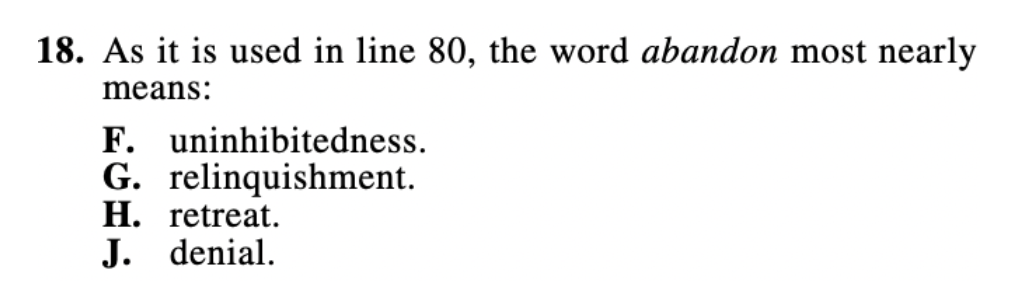
On the ACT, these questions always refer to a longer passage. That has a big advantage: you’ll have lots of context to help you determine the likely meaning of a word.
What’s more, vocab words on the ACT tend to be significantly easier than those on the SAT. Compare the two questions above. In the ACT question, “abandon” isn’t a complex word by itself, and out of the answer choices, at least two are words that almost all students will know. In the SAT question, you might not know any of the four words in the answer options.
Finally, the SAT simply tests more vocab. You’ll get around 8-10 vocab questions on the SAT, compared to something like 2-3 on the ACT.
If you’re a vocab buff, great! But for most students, choosing the less vocab-heavy test may translate to a higher score.
3. The SAT has more complex Reading questions
At first glance, the ACT’s Reading questions may seem more complex than the SAT’s: the ACT uses longer passages that come with a set of questions, while the SAT gives you a paragraph-length passage for each individual question.
The questions themselves also matter, though. On the ACT, there are more general reading comprehension questions that test whether you’ve understood the point and tone of the passage, like these examples:

SAT questions vary in difficulty, of course, but the SAT does include some tricky question types that you won’t see on the ACT. While both tests will ask you to identify main ideas and details, understand perspectives, and compare texts, the SAT has some extra categories.
For example, you’ll be asked to use new, hypothetical evidence to evaluate a claim, like in this question:

This is a ton of information to synthesize for only one question! If you’re a fast skimmer and don’t want to keep a longer text passage in mind as you answer questions, the SAT might be easier for you—but if not, the ACT is likely the easier test.
4. The ACT gives you less time per question—but that’s reflected in the question difficulty
The ACT gives you quite a bit less time per question than the SAT—as little as 42 seconds per English question and just 67 seconds for Math and Reading questions, compared to 71 seconds on SAT Reading & Writing and 95 seconds on SAT Math.
But there’s a reason for that. On SAT Reading & Writing, you have to read a new passage for every question. True, the passages are short, but it still adds up to a lot of reading and analyzing. On the ACT, each passage is longer and comes with a set of questions, so you don’t need to get into a whole new topic on each individual question.
ACT Math is also easier for many students than SAT Math. Yes, there are easier and harder questions on each test, and both Math sections put the hardest questions towards the end. But, like for Reading & Writing/English, ACT Math tends to spend less space setting up each question than SAT Math, which tends to make the problems less complex.
ACT Math is also fully multiple-choice, meaning that in a time crunch, you can always guess (neither test has a “guessing penalty,” so you don’t lose points for wrong answers). SAT Math still includes open-answer questions.
5. You can still get a perfect ACT score with a lower score on one section
If you’re aiming for a perfect score, the ACT might be the way to go.
Because your total score is the average of your Math, Reading, and English scores, you can get a perfect 36 on the ACT even with an imperfect score on one of those sections, like this:
| Section | Score |
| Reading | 36 |
| Math | 36 |
| English | 35 |
| Composite score | (36 + 36 + 35) / 3 = 35.66 → 36 |
On the SAT, your score is simply your Math and Reading & Writing scores added together. That means that even if you drop 10 points (the smallest possible number) on one section, you can say goodbye to a perfect score:
| Section | Score |
| Reading & Writing | 790 |
| Math | 800 |
| Composite score | 1590 |
To be clear, a near-perfect score on either test is still a great achievement! You do not need a perfect 36 or 1600 to get into a great college, or to win many merit scholarships. But if it’s what you’re hoping for, keep this in mind.
Of course, the best way to boost your score is to be well-prepared. Here’s where an experienced test prep tutor can make all the difference. Give us a call for a free consultation to figure out how tutoring can help you.
You can get a perfect 36 on the ACT even with an imperfect score on one section
When the SAT Might Be Easier
Of course, all of the above is true for students in general. Your personal experience might be different. Here are some situations where you might find the SAT easier than the ACT to get a high score on:
- Math is your strong suit, and you want to use your Math score to compensate for a lower Reading & Writing/English score.
- You do well at vocab questions.
- You’re a fast reader comfortable skimming a new text for each question.
If you’re still unsure which test to pick, try taking a diagnostic test for both the ACT and the SAT. Stay within the time limits and give yourself the same constraints you’ll have on test day (no phone, no looking things up), and see which test plays to your strengths better.
Next Steps
Now you know some of the key differences between the ACT and SAT. Still not sure which test to take? Compare our full guide to the sections of the SAT and our deep dive into the ACT.
And once you’ve chosen your admissions test, consider working with one of our expert test prep tutors. They’ll be able to help you identify the skills to work on and learn strategies to hit your goal score.
Top SAT and ACT Posts
- The 15 Best Online ACT Tutoring Services
- The 14 Best Online SAT Tutoring Services
- 25 of the Hardest SAT Math Questions
- The 4 Types of ACT Reading Passage
- ACT Score Calculator
- 15 Hardest ACT Math Questions (With Solutions)
- ACT Reading: Everything You Need to Know
- 18 ACT Grammar Rules You Must Know for a Perfect Score
- ACT Superscoring Explained
- The Key Strategy for Every SAT Reading & Writing Question Type
- SAT Grammar Rules for a Perfect Score
- Digital SAT Scoring Guide

Ro
Ro is an experienced test prep (SAT/ACT), college essay, and academic (English, French, Latin & math) tutor who has been tutoring since college.
Her test prep students have scored in the top 1% on the SAT and regularly see score increases of 100+ points over a few months. She especially enjoys helping her academic tutoring students to find enjoyment in subjects they used to struggle with.
Ro holds a BA summa cum laude in Comparative Literature from Princeton University and an MA in Law & Religion from KU Leuven, Belgium